For women in perimenopause and menopause

Find the words for what’s changing.

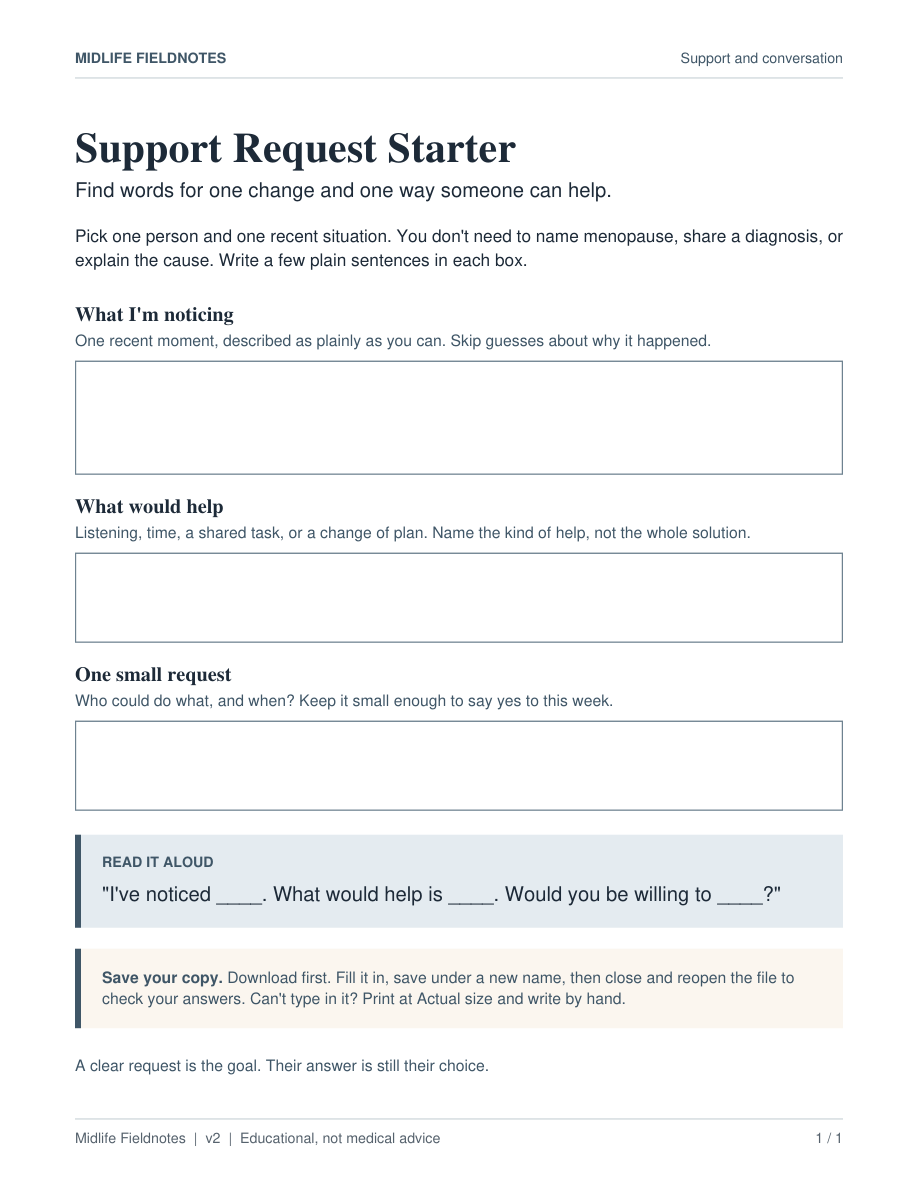
A free one-page worksheet to explain one change to someone close to you, then ask for one specific kind of help.

Download the free worksheet

Free PDF · 1 page · 3 fillable boxes · No email or account

The free Support Request Starter worksheet with three fillable prompts.
Support Request Starter · free

01 How it works

Three boxes. One request.

  1. Notice

    Describe one recent moment in plain sentences. Skip the explanation for why it happened.

  2. Name the help

    Pick one kind of support: listening, time, a shared task, or a change of plan.

  3. Ask

    Choose one visible action with a day and time. Say it as a question you can hear a yes or no to.

Your first draft

“I’ve noticed ____. What would help is ____. Would you be willing to ____?”

You don’t need a diagnosis or a cause to start.

02 Example

What a finished request can sound like.

Mara wants a quieter evening at home. Her words describe her situation. Use only the parts that fit yours.

Fictional example · Mara

What I’m noticing
After work this week, I’ve been running out of energy by dinner. Yesterday I tried to cook and answer everyone’s questions at once, and I felt overloaded.
What would help
A quiet break when I get home, and someone else taking dinner off my list twice this week.
One request I can make
Could you handle dinner on Tuesday and Thursday, and give me 20 minutes alone after work on those days? We can check in on Sunday about how it went.

How Mara might start

“I want to explain what evenings have been like for me and ask for a small change this week. Is now a good time for a short conversation?”

If those days don’t work

“Which evening could you take dinner? I can simplify the other night. I still want to protect that short break.”
Download the completed example, free

03 The kit

The free sheet gets you the first sentence. The kit gets you the whole conversation.

The kit adds what one sheet can’t hold: scripts for four settings, language for pausing, two complete examples, and a plan you can fill in and keep.

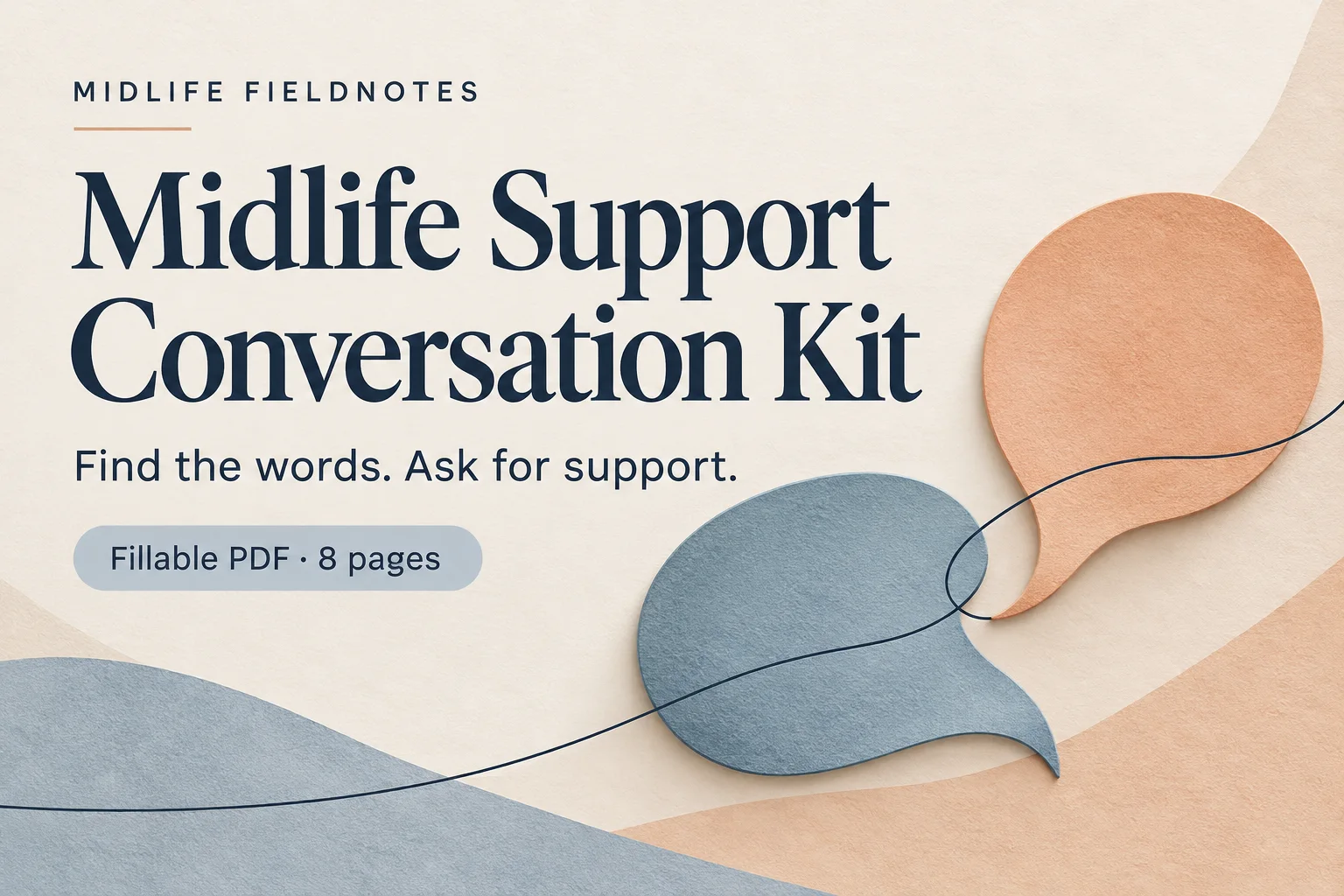
Cover of the Midlife Support Conversation Kit: Find the words. Ask for support.

Midlife Support Conversation Kit

$19.99 USD

One-time purchase · Fillable PDF · 8 pages · Download after purchase

Get the kit for $19.99

An educational communication tool, not medical care or therapy.

Scripts from page 4. Choose a setting.

Split the evening routine

“Evenings have felt more demanding lately. Could we split the routine this week? You take dinner Monday and Wednesday, and I’ll handle cleanup the other nights.”

Name the days and tasks. If you live alone, ask one friend or neighbor to help with one practical task instead.

Ask for listening

“I’ve been finding it hard to explain what feels different. Could you listen for a few minutes without trying to fix it? Afterward, I’ll tell you whether I want ideas.”

Ask when your friend has room to listen, and say what you need before you start.

Share the care

“I’m caring for Dad more than I can manage alone. Could you stay with him this Saturday from 9 a.m. to 1 p.m. so I can take a break?”

Choose one responsibility and one day. A different day or one ride to an appointment can be an alternative. Start with one request.

Ask for one clear priority

“I do my best work when I focus on one priority. Could we agree on today’s top task and put the other requests in writing? That would help me plan.”

Share only what you choose. This script isn’t guidance on legal rights or accommodations. For those, check your employer’s policy or HR.

Inside, page by page

  1. p. 2

    Name it, then ask

    Turn a broad feeling into a request someone can act on.

  2. p. 3

    Open the conversation

    A first message, an adaptable script, and replies for yes, part of it, no, or not yet.

  3. p. 4

    Four everyday situations

    Home, friendship, family care, and work.

  4. p. 5

    Pause without losing the thread

    Words for losing your place, feeling overloaded, or a talk that turns into blame.

  5. p. 6

    Two complete examples

    Elena’s family care plan and Maya’s protected focus time at work.

  6. p. 7

    Your conversation plan

    Six fields: person, noticing, help, request, opening, and fallback.

  7. p. 8

    Keep what helps

    Three fields to record what happened, what was agreed, and your next step.

04 Questions

Before you decide.

Is this therapy or medical advice?

No. These are educational communication tools. They don’t diagnose, treat, or explain why you feel different.

Do I need a partner to use this?

No. Start with someone you trust: a friend, family member, partner, or another person in your life.

Can it guarantee they will say yes?

No. Preparation can make your words clearer. It can’t make someone agree, understand, or change.

Do I have to share my answers?

No. The PDF doesn’t send your answers anywhere. Your PDF app may keep its own copies, so check its settings.

What do I get after buying the kit?

A download of the fillable 8-page PDF after purchase. Save a copy under a new name before you type.

Can I use it on my phone?

Open the PDF in an app that supports fillable forms. If the fields don’t work, print at actual size or copy the prompts into your notes app.

Start with one sentence.

Download the free worksheet now. Decide about the kit later, when you know what you need next.

Download the free worksheet

Free PDF · 1 page · 3 fillable boxes · No email or account